

Academics - Current Status
Running Start
Running Start enrollments for 2016-17 were at 846 FTE at the Running Start rate and 42.5 at the Running Start vocational rate. The program in 2016 brought in 161% of budgeted revenue and thus far in 2017 has brought in 120% of budgeted revenue.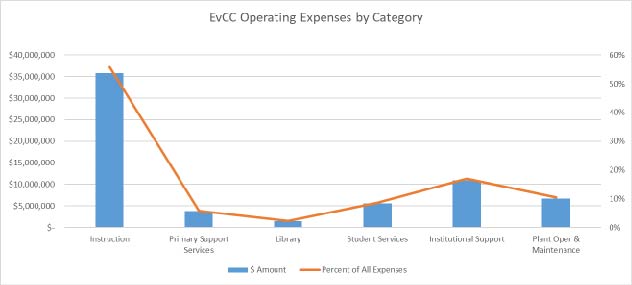
College in the High School
The College in the High School (CHS) program is a cooperative program between EvCC and local school districts. CHS teachers are approved by the respective College academic departments and meet the academic department’s requirements for teaching the specific college course. The qualified high school teachers work closely with EvCC faculty mentors to ensure that the work that the students perform in the high school course is equivalent to the same course taught on campus. EvCC’s program is NACEP accredited (National Association of Concurrent Enrollment Programs), the only program among the state’s 34 CTCs to meet this nationally recognized standard of quality. National Student Clearing House data revealed superior transfer and completion outcomes for students in College in the High School and other dual enrollment programs.
The College recently leased space at Weston High School in Arlington for advanced manufacturing and continuing education programs.
For over five years, the North County community has asked for a higher education presence
Establishment of this program represents robust engagement with partners
The vision is a smaller-scale AMTEC to bring higher education to North County
Providing contract training with employers as well as professional development programs through CCEC
Hoping for strong enrollment to fund the campus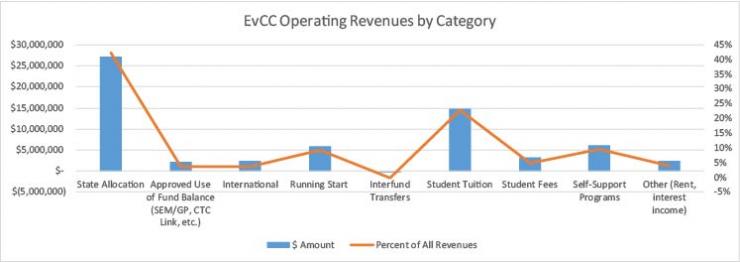
Guided Pathways
Guided Pathways work aligns curriculum so that students know what classes to take and when, so that their journey at Everett Community College is clear, with a direct outcome to employment or transfer. Student completion is the focus of this work, and increasingly will be the source for state funding in the future.
By mapping the learning outcomes of individual courses into an intentional sequence that meets all program learning outcomes, EvCC will strengthen the systematic nature of the assessment process and further ensure that students are learning.
Grant funding provides ability to focus on changes in advising and program mapping
Program advising, software updates, intake process, math pathways, and intake process in advising all impacted
Five new Guided Pathways advisers hired to focus on the 8 pathways options
Heart of this work is to have clear pathways, clear advising, and clear mindset of equity work across all disciplines
SEM
The College’s Strategic Enrollment Management (SEM) Council was reorganized in 2016 to revise the comprehensive SEM Plan. The SEM Council began with Five Areas of First Focus that represent significant opportunities to better attract and support students: High School Outreach, Transitional Studies/Student Retention, K-12 Student Retention and Partnerships, Diversity and Equity, and Funding for Students. Strategies and tactics to address each First Focus area were developed in time for the 2017 budget planning process, presented for input to Guided Pathways faculty leads, VP Staff, Deans Council, SEM Council, Faculty Advisory Group, the campus community during the budget planning process, and the BOT.
Phase two (March 2017 - November 2017) included implementation teams for each area and the development of the institution-wide SEM Plan, including broad, multi-year enrollment and retention strategies, resource prioritization, environmental scanning, performance metrics, and ongoing campus engagement.
In order to create a strong and growing pipeline of students enrolling in the institution that are served seamlessly en route to achieving their education and career goals, SEM will:
- Increase access for all students, especially under-represented populations.
- Support predictable, growing enrollments (FTE) aligned with performance-based funding frameworks.
- Improve student retention, completions and transition to 4-year institutions or employment by working in alignment with Guided Pathways (GP), Achieving the Dream (ATD), and other student success efforts.
SEM’s goal is to attract, enroll, retain, and complete students
SEM helps EvCC to fulfill its mission of expanding equity, access, and success for all students
SEM plan development is led by a 15-member SEM Council, which includes faculty, staff, and student representatives
Current initiatives include mini-scholarships for GED students and HSC students in transitional studies
Current areas of first focus include student funding, outreach and recruitment, transitional studies, student retention/completion, diversity and equity (throughout)
Goals include: increasing matriculation of CHS tuition waiver recipients; increasing matriculation of GED completers to college-level coursework; increasing the enrollment of Latino, Asian, Native American, Pacific Islander, and African American students each year for the next five years; integrate with, augment, and align the high school outreach plan
International Education
To date, international enrollment has exceeded projections, but it remains market-driven, as the U.S. and global economies are key factors in the number of students able to attend from specific countries. Program administrators monitor international trends and pursue opportunities in existing and emerging markets. Staff project continued growth but remain conservative for budgeting purposes. The College has observed slight reductions in revenues in this area over the last two years due to the state’s decision to decrease tuition by 5%. Despite this reduction, International Education continues to be a strong contributor to College revenues. International Enrollment revenue came in at 35% of budget in 2016.
The rapid growth of the College’s international program, the result of a commitment to expand international student presence, represents one means for providing students with opportunities to meet and learn from members of other nationalities and cultures. The program has grown by 500% in recent years, and now includes students from more than 30 countries. The Office of International Programs has developed ways to integrate international students through Cultural Sharing Days, the creation of the International Student Ambassador program, and by establishing an informal conversational English partnership program that allows international and domestic students to meet one another and discuss the similarities and differences of their respective cultures.
A number of partnerships among College departments and external organizations have also contributed to new opportunities for students to prepare to participate in global environments. For example, through the Japanese Language Fluency for Undergraduates program funded by a Department of Education Title VI grant, the NBI developed a 2016 student internship at small businesses in Nagoya, Japan, that provided students with opportunities to apply communication and cultural skills to practical working situations. NBI has also continued to collaborate with local Everett and Japanese businesses, educational institutions, and local Japanese governments to expand internship opportunities; in 2016, NBI partnered with the cities of Kobe and Kakamigahara to create future exchange and internship programs.
Currently, there are 450 international students, and the program is self-support
Each year, the International Office creates a new strategy for outreach to various countries
College expectations drive the work of the International Office, which then leads to staff creation of strategies
In 2017-18, Vietnam is the number one country for international student enrollment at EvCC, followed by China and Indonesia
The plan is to grow the program to 600 students for 2018-19
Advising
The GP model will continue to require entry advising with a faculty advisor for all new students before they register for their first quarter. Students who receive entry advising are referred to a faculty program advisor to complete mandatory advising and develop an academic plan.
The College evaluates the effectiveness of entry advising by analyzing the quarter-to-quarter and fall-to-fall student retention rates, and student achievement points in pre-college math and English, completion of 15 and then 30 college credits, college-level math, and degree or certificate completion. The mandatory advising requirement for all degree-seeking students is published in the catalog, class schedule, and on the EvCC website and is distributed and made available to all students during the admissions process as well as online orientation.
The College requires all new certificate and degree-seeking students to meet with an entry advisor to select first quarter courses before registering. The College maintains and regularly updates web-based advising resources, curriculum guides, program and graduation requirements, etc., and the student’s academic plan is posted in the online Degree Audit system where it is accessible to the student.
Advising has experienced significant changes with new administration, along with Guided Pathways
Advising plays a key role in the SEM pipeline and maintaining and growing enrollment
Growth of advising role means needs for IT and infrastructure, along with space needs
Goal of adding extended drop-in hours and increased appointment availability
Instruction
The Instruction budget includes general academic programs, technical instruction programs, community education, and transitional studies. Everett Community College spends a greater portion of its operating budget on instruction than other community and technical colleges in Washington. While some of this difference may be attributed to coding systems, more likely this is a difference in priority. Everett Community College spends over 50% of its operating budget on instruction, because instruction is valued and is at the heart of the college mission.