

Current Status
Grants
- Important funding source for college
- Part of Resource Development department
- Partially funded through operating budget since FY 2009-10
-
Resource Development Personnel
- Executive Director of Institutional Effectiveness and Resource Development
- Executive Assistant
- Grants Director
- Grants Specialist
- Fiscal Analysts (2) report through accounting business unit
-
Reason for not fully self-supported department
- Cyclical and uncertain nature of grant funding – particularly federal grant programs (indirect funding)
-
Federal & State Grants – mostly offset different costs of RDD
- Grant acquisition
- Management
- Evaluation
- Compliance activities
- Exception for budget increases – Salary increases & rising benefit expenses
-
Annual Grant Award
- Average $6.4 M between 2010-11 & 2015-16
- Maximum just over $10 M in 2015-16
- Minimum just under $4M in 2013-14
- Projections $7 M average through 2019-20 (constant) – to support continued College innovation & sustainability
-
Major sources of EvCC’s grant funding
- U.S. Department of Labor
- U.S. Department of Education (TRiO & Title III funding)
- National Science Foundation (supports number of academic programs)
- College Spark Washington (private foundation funder – supports critical projects)
- Washington State 1000 FTE funding - regular addition to College’s allocation due to consistently meeting performance goal
-
Funding projection at federal and state level – somewhat pessimistic
- Increased competition for federal funding
- Congressional partisan conflicts impact the size and availability of many ongoing federal grant-funded programs (includes DOE, DOL & NSF)
- Workforce legislation (WIOA) changes
- Pending re-authorization of Higher Education Act
- Continued pressure on Washington state budgeting – impact Workforce Development Council programs support through community college funding
-
Resource Development office funding focus
- Private foundation monies
- Corporate support focused on innovations and capacity building (supports EvCC’s Strategic plan achievement)
- Collaborative work with other two-year & four-year colleges, K-12 districts, employers Workforce Snohomish & other community partners
- Highly trained and experienced fiscal and grant acquisition and management staff positioned EvCC as a leader of consortium grants (DOL TechHire grant awarded 2015-16).
- These larger collaborative grant awards contribute to total grant awards fluctuation year to year
State Allocation
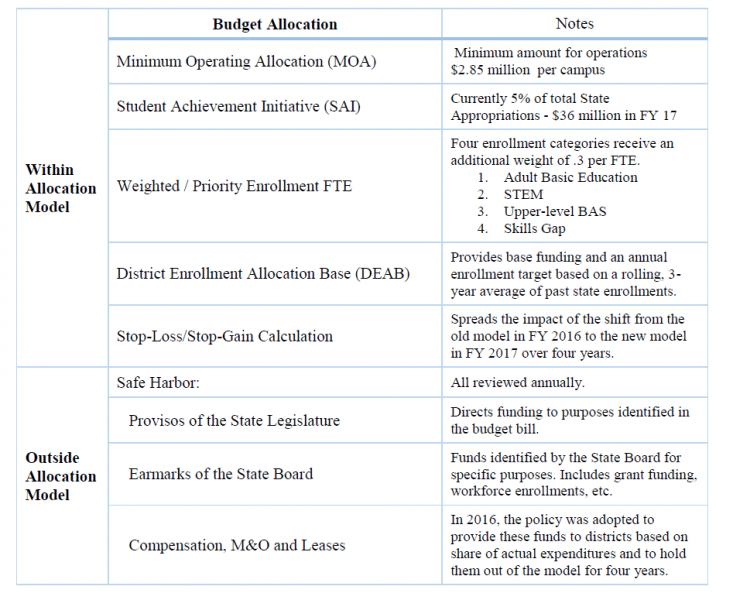
- New Allocation Model: Key Components

-
Effects of new model:
- Reduction of state funding – Pie is finite and based on college success
- Weighting of high-demand enrollments tends to favor technical colleges (1.3 v 1.0 FTE)
-
College focus:
- Meeting state enrollment targets
- Increasing student achievement points
- SBCTC Safe Harbor plan – spreading out the significant gain/losses over the first four years.
- Interim enrollment success may offset the loss
- Failure to meet enrollment targets and student achievement goals may worsen the loss.