

Kristine Washburn Problem Solving
Real problems for real problem solving
By Kristine Washburn, Full-time Faculty, Physics Department
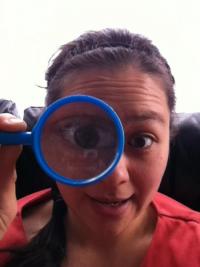 I've always been fond of applying physics to everyday situations. A few years ago the Physics department realized that all the students google all the homework problems every week and aren't learning from it. We all came up with novel ways to combat this. My solution: assign simple physics problems that involve taking measurements of things that exist. Students can google the answer to the textbook question about kinematics but if I tell them they need to measure the acceleration of their car they can't cheat their way out of it. And since they're mostly engineering majors I feel I'm doing them a huge service by making them apply what we're learning to the physical world and not the textbook one.
I have a couple "application projects" I really love. In one of them, after a lesson on hydrostatics, they have to calculate the length of the longest straw you can drink from. Then they have to tape straws together until they've made the longest straw they can actually drink from and discuss why their straw is not as long as their calculated answer. I love this one because a lot of students get their kids and friends involved. They have to turn in a photo of themselves drinking from their straw and they always look like they're having fun with it. Another one I love involves students rubbing their feet on the carpet and shocking a friend. They measure the distance to the friend and calculate the electric potential they generated. This one always seems to get assigned on weeks when it's rainy so the students often end up seeking out indoor playgrounds and using plastic kiddy slides to generate enough charge to shock a friend. 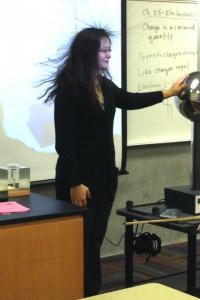
I do a lot of flipped classroom type stuff and always give students problems to work on in class. A lot of them involve students taking quick measurements in order to calculate something. The problems are straight out of a textbook but don't come with numbers; the students supply those. In optics, I have students use lasers and diffraction to measure the width of their hair. I have them calculate how far the water will shoot out of a bucket with a hole in the side before doing the demo to see if they're right.
 I think 20 years from now all of these students will have forgotten the details and equations. But if they really learned, then they'll still have the concepts. Those are the parts they'll use. So I try to emphasize those. I find that the problem-solving part doesn't suffer one bit for it either.
For more information contact Kristine at kwashburn@everettcc.edu.
Connect with us!

